
Buying Guide
Compatibility and platform support
First, confirm the controller works with the devices and software you intend to use. Look for explicit support for PC, consoles, or mobile OSes (Android/iOS), and check whether the controller needs drivers or a mapping app for certain titles. See our picks for best pc game controllers.
- If you mainly play on PC and want plug-and-play simplicity, a wired pad with a console-style layout can be the easiest choice — for example, the Logitech G F310 is a straightforward wired option that many users pair with Windows.
- For mobile gaming, verify clamp or phone size support and whether the controller uses Bluetooth or a USB-C connection. For phone-specific pads check our best gamepads guide.
Connection type and latency
How the controller connects affects responsiveness. Wired USB connections typically offer the lowest latency and no battery concerns. Wireless options vary: Bluetooth is convenient but can introduce lag in competitive play; 2.4GHz dongles tend to be faster and more consistent.
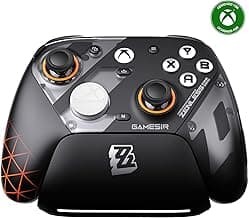
- Look for controllers that publish polling rate or low-latency modes if you play fast-paced or competitive games. The GameSir Cyclone 2 Wireless Controller is an example that emphasizes a high polling rate for reduced input lag. See our best game controllers roundup for models noted for low latency.
- Also consider whether the controller supports both wired and wireless modes so you can switch depending on the session.
Controls and input quality
Pay attention to the D-pad, analog sticks, triggers and any shoulder or back buttons. Hall-effect or TMR sensors are more durable and resist drift, while analog triggers with fine travel give better throttle control in racing games.
- Try to find controllers with mappable buttons if you want custom control schemes or extra inputs for complex games; our best music game controller picks include many models with robust remapping options.
- Check user feedback on stick feel and D-pad precision—some pads are better for fighters and platformers, others for shooters.
Ergonomics and build quality
A controller you can hold comfortably for hours will improve play and reduce fatigue. Consider grip shape, button spacing, weight, and materials. Interchangeable D-pads or swappable thumbsticks are useful extras for tailoring feel without buying a new unit.
- Look for durable faceplate and button construction if you expect heavy use, and read reviews for common hardware issues like loose bumpers or cracked housings.
- If portability matters, check dimensions and whether the controller comes with a carrying case or dock.
Battery life, extras and ecosystem
For wireless controllers, battery life and charging convenience matter. Also evaluate extras that add long-term value: vibration, audio passthrough, charging docks, software for remapping, and active developer support or firmware updates.
- Consider whether the vendor offers an app for remapping or sensitivity tuning—this can extend the controller’s usefulness across multiple games.
- If you rely on long sessions, choose a controller with a larger battery or easy wired fallback, and check replacement part availability if you expect heavy wear.
FAQ
What is a MIDI game controller and can I use a regular gamepad as a MIDI controller?
A MIDI controller usually sends musical data (notes, CCs) rather than game input, but you can repurpose a regular gamepad by translating its buttons and axes into MIDI messages with software. Many mapping tools will let you assign stick movement, triggers, and buttons to MIDI notes or continuous controllers. Expect some setup time to calibrate dead zones and sensitivity so mappings feel musical. Also watch for latency—wired connections and low-polling controllers reduce delay when playing in real time.
How do I map a game controller to MIDI on a Windows PC?
Start by installing a virtual MIDI port (for example, a loopback MIDI driver) and a controller-to-MIDI translator program that accepts gamepad input. Connect your controller, open the translator, then bind buttons and axes to MIDI notes or CC messages and choose appropriate MIDI channels. Test mappings inside your DAW or synth and tweak sensitivity, thresholds, and note ranges for usable musical response. Save profiles so you can quickly switch mappings for different instruments or performances. If you need devices that support USB-MIDI or wired connectivity, see our best usb music controllers guide for compatible hardware examples.
Which controller features matter most if I want to use a gamepad for MIDI control?
Look for precise analog inputs (smooth sticks and triggers), remappable buttons or back paddles, low-latency wired modes, and the ability to save profiles—those make musical mapping more expressive and reliable. Hall-effect or TMR joysticks and analog triggers tend to be more stable over time, which helps avoid drift in continuous controllers. If you want a high-performance example to consider, the GameSir G7 Pro is a versatile option with advanced joysticks and high polling modes that many users map to MIDI. Always verify mapping support with your chosen software before buying.
Can I use a mobile game controller with iPhone or Android music apps?
Yes—many mobile controllers work with Android and iOS apps either over Bluetooth or via USB-C/OTG connections; check the controller’s compatibility with your phone model and OS version. On iOS, some apps accept standard controller input or MIDI over Bluetooth, while on Android you may prefer a USB-C wired connection for lower latency. For compact mobile use, the GameSir X5 Lite is a popular phone controller that supports USB-C connections for recent phones. Always confirm the app you plan to use can receive controller input or that you have a translator app to convert inputs to MIDI.
What's a good budget controller to try controller-to-MIDI mapping without spending much?
Choose an affordable controller with reliable sticks, remappable buttons, and at least a wired mode to minimize latency—those features are most important when you're testing MIDI workflows. Budget wireless options that include hall-effect or TMR-style sticks offer better long-term stability than cheap analog-only units. A solid low-cost example is the GameSir Cyclone 2, which many users buy for experimenting thanks to its versatile connectivity and stable joysticks. Start with simple mappings and expand complexity as you learn how the controller behaves with your software.
Final Verdict
Across tests the strongest midi game controllers separated themselves by input reliability, low-latency connectivity, and configurable controls. Controllers with Hall- or TMR-style sticks, high polling rates, remappable buttons and solid build quality consistently outperformed simpler models. Buyers should prioritize joystick sensor type, connection mode (wired vs wireless), polling rate/latency, and ergonomics. Top performers combined precise inputs, responsive connections, and durable construction.
🏆 Best Overall: Logitech G F310 Wired Gamepad (Console Layout)
💰 Best Budget: GameSir Cyclone 2 Wireless Controller (TMR Joysticks)
⭐ Best Premium: GameSir G8 Plus Bluetooth Mobile Controller (Hall Joysticks)