
Buying Guide
Sound quality and channel configuration
For budget soundbars, clarity and dialogue handling matter more than headline wattage; see our best budget soundbar picks for options that prioritize vocal clarity. Look for a unit that prioritizes vocal clarity and balanced mids so TV shows and movies are intelligible at low to medium volumes. Simple channel counts—2.0 (bar only) and 2.1 (bar + sub) —will cover most living rooms; virtual surround or night modes are useful add-ons but don’t rely on them to replace a full surround setup.
- Check reviewer comments for words like “clear dialogue” or “no distortion at normal volume.”
- Consider a 2.1 option if you want deeper low end without buying a separate amp.
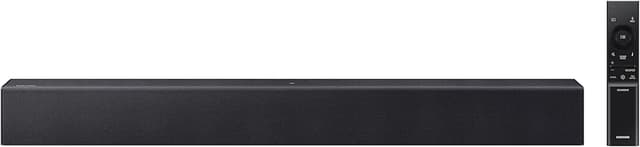
- For a reliable everyday option, the Sony S100F is frequently recommended for clear, balanced sound in compact setups.
Connectivity and wireless features
A budget wireless soundbar should offer straightforward wireless pairing plus at least one wired input to match your TV. best wireless soundbar roundups can help you compare Bluetooth, Wi‑Fi, and HDMI ARC implementations. Bluetooth is the baseline for streaming from phones; HDMI ARC (or eARC on newer TVs) and optical inputs handle TV audio and provide simpler remote control integration.
- Prioritize HDMI ARC if you want the TV remote to control volume and power. Optical is a solid fallback.
- Bluetooth version matters less than stable pairing—look for recent reviews that confirm reliable connections.
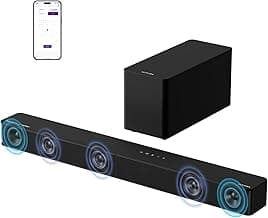
- If app control or multiple input options are important, mid-range budget models like the ULTIMEA Poseidon M30 pack HDMI, optical, Bluetooth and app features without a big price jump.
Size, placement and room fit
Choose a size that matches your TV and viewing distance. A soundbar that’s too small can sound thin on a large TV; one that’s too big may block sensors or look disproportionate. Compact bars are great for desks, small bedrooms, and tight TV stands; longer bars work better for wider TVs and living rooms.
- Measure the space on your TV stand or the width under the screen before buying.
- Wall-mounting capability is a plus if you plan to hang the TV; check for mounting brackets or keyholes.
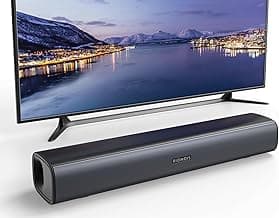
- For very compact setups, consider the Saiyin 11.7-inch compact soundbar—small footprint, designed for desks and small TVs.
Bass, subwoofers and EQ control
Bass performance is one of the biggest trade-offs on budget models. Built-in subwoofers can be convenient but will not move as much air as a dedicated external sub. If you want punchy low end, choose a soundbar with a wireless subwoofer or good EQ presets and adjustable bass levels. If you’re chasing immersive height and low-end impact on a budget, our best budget dolby atmos soundbar recommendations highlight models that squeeze extra spatial dynamics into affordable designs.
- Decide whether a built-in sub is adequate or if a separate wireless subwoofer is worth the extra space.
- Look for basic EQ modes (movie, music, dialogue) and bass adjustment so you can tailor the sound to content and room acoustics.
- Read user feedback about bass bloom or muddiness—some budget bars sound fuller in small rooms but lack definition on action scenes.
Setup, controls, and long-term support
Ease of setup and reliable remote/firmware support make a big difference in daily use. Simple plug-and-play HDMI ARC or optical setups reduce frustration; a clear remote and onscreen prompts speed configuration. Also check return policies and warranty for peace of mind with budget purchases.
- Prefer models with clear setup guides and simple input switching if you use multiple devices.
- Look for firmware updates or app support if you want ongoing improvements—some budget brands offer app features that improve usability over time.
- Before buying, verify the seller’s return window and warranty so you can test the soundbar in your room and return it if it doesn’t meet expectations.
FAQ
What should I look for when shopping for the best budget wireless soundbar?
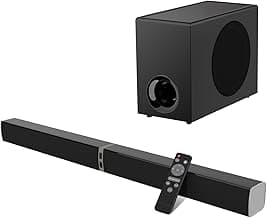
Focus on three things: the wireless connection type (Bluetooth vs. Bluetooth + Wi‑Fi), the available inputs on your TV (HDMI ARC or optical), and whether you need a subwoofer for low end. Look for basic sound tuning or EQ modes and a mode for dialogue clarity to improve TV shows and news. Size matters—choose a soundbar that fits under your TV without blocking sensors or the remote. For tight budgets, compact 2‑in‑1 models often give the best mix of features and price; one example is the Detachable 2‑in‑1 Soundbar.
Can a cheap wireless soundbar give better bass for movies?
Yes, but it depends on design—built‑in subwoofers or bass‑reflex ports improve low frequencies much more than a slim single‑driver bar. Wireless subwoofers usually deliver deeper, room‑filling bass than compact all‑in‑one units, so look for a 2.1 system if bass matters. Keep expectations realistic: budget bars won’t match a full AV receiver and speaker setup, but they can noticeably boost impact for action scenes. Placement and room size also influence perceived bass—corners and walls reinforce low end.
Will a budget wireless soundbar work with my streaming stick and game console?
Most budget soundbars support Bluetooth and at least one wired input (HDMI ARC or optical), which covers streaming sticks and modern TVs. For consoles, use HDMI ARC if available to keep low latency and full audio formats; otherwise an optical cable works fine for stereo and basic surround. Bluetooth is convenient for phones but can introduce lag for gaming, so prefer wired connections when playing competitively. If low latency and game-specific features are a priority, check our best gaming soundbar recommendations to find models tuned for players. Always check your TV’s output options before buying to ensure compatibility.
How hard is setup for a budget wireless soundbar?
Setup is usually straightforward: place the bar under the TV, connect HDMI ARC or optical cable, plug in power, and pair Bluetooth if needed. Many models offer auto‑detect or simple remote controls and include wall‑mount templates for a quick install. If you want one‑cable simplicity and TV control, pick a soundbar with HDMI ARC/CEC. For a particularly easy, compact option, the Sony S100F is known for quick setup and clear voice performance: Sony S100F.
Which budget wireless soundbar is best for a small apartment?
In small spaces choose a compact bar with controlled bass so you don’t disturb neighbors—shorter enclosures and adjustable bass are helpful. Look for models with wall‑mount options and multiple EQ presets so you can tailor sound without cranking volume. If space is very tight, a compact 11–12 inch soundbar can improve clarity without overwhelming the room; the Saiyin 11.7‑inch Soundbar is a practical example of a small, budget‑friendly unit. If you prefer a portable or speaker-focused option, also compare the best budget bluetooth loud speakers picks for alternatives that are neighbor-friendly. Also check for night or late‑night modes that compress bass and dynamics for neighbor‑friendly listening.
Final Verdict
After comparing budget wireless soundbars, the strongest models stood out for reliable Bluetooth and HDMI ARC connections, meaningful bass support (built-in subwoofer or bass-reflex design), and clear dialogue from simple EQ modes. Weaker options saved cost at the expense of steady wireless pairing and usable low end. Prioritize consistent wireless connectivity, multiple inputs (ARC/optical/aux), and adjustable bass or EQ. The top performers shared straightforward setup, stable pairing, and balanced sound that improves TV and movies without extra fuss. For broader comparisons including higher-end features, see our best soundbar guide.
🏆 Best Overall: Sony S100F 2.0ch Soundbar with Bass Reflex & Bluetooth
💰 Best Budget: Sound Bar for Smart TV (Detachable, Bluetooth / ARC)
⭐ Best Premium: RIOWOIS Sound Bar with Bass Reflector — Wall Mountable